Wood Decks

We could not be more pleased with High Rock Exterior's work replacing our deck's old wood decking and railing with Timber Tech's Advanced PVC decking and cable railing. The large irregularly shaped deck required High Rock's installation experience and diligence to deliver a perfectly installed deck and railing. What we got with High Rock was a transparent and very detailed proposal and bid up-front. The bid also clearly spelled out contingencies for dealing with the uncertainties of putting new materials on the old substructure. Mason was on-site every day, keeping us informed of the progress, best installation practices, and explaining any design options. He is a great communicator, and particular (in the good way). His team, James, Calvin and Cade, worked hard, and worked smart. They have built enough decks that, on their own, they applied that knowledge and quality standards in their work. Follow-up was great; no issues were left to address when the work was finished within the time frame that was bid. We chose the top of the line Timber Tech materials, and we experienced a top of the line install. In our view, it is perfect, as was our experience with High Rock, Mason and crew.
Soft Wood Decks
Natural wood deck are hard to beat in terms of aesthetics. California Redwood, Western Red Cedar, Accoya are all excellent decking options. Each is best suited for particular types of decks available in a multitude of grades and colors. You can find just about anything to suit your style and budget.

Western Red Cedar decking
From golden honey to warm chestnut, the range of colors in addition to the natural rot resistance of Western Red Cedar makes it an optimal choice for pergolas, trellises and decks.
California Redwood Decking
For a durable and sustainable decking material with a warm tonal range and rich reddish-brown coloring, look at California Redwood.
Accoya Wood Decking
Accoya wood is made by Accsys at its plant in Arnhem, Netherlands. They turn fast-growing, certified sustainable wood into a high-performing, sustainable lumber with sustainability credentials.
Pressure Treated decking
Pressure treated wood is an amazing asset for the deck framing and support structure as it lasts much longer than un-treated wood, significantly increasing the lifespan of your deck.
Hard Wood Decks
In addition to the great look of a natural wood deck, tropical hardwoods are highly resistant to rot, decay, insects and other forms of deterioration. There are several varieties of tropical hardwoods to choose from, including Brazilian Ipe, Tiger Wood, Teak and Mahogany. Hardwoods can perform well for 25 to 50 years with proper maintenance.
IPE (Brazilian Walnut)
One of the strongest woods, Ipe is a dense tropical hardwood that is durable enough for any climate and is naturally resistant to rot and decay.
Tiger wood
Brazilian Tiger is an extremely rich, beautiful hardwood with a reddish hue and sometimes has a prominent darker grain pattern which gives it a unique look.
Teak
Teak is a lighter colored hardwood than Ipe and is also less dense making it lighteer and generally easier to work with. Its color ranges from yellow brown to dark golden brown.
Mahogany
Mahogany is a classic decking look that is always a great fit. It looks great and it’s also less expensive and requires relatively low maintenance compared to other options.
manufactured Wood Decks
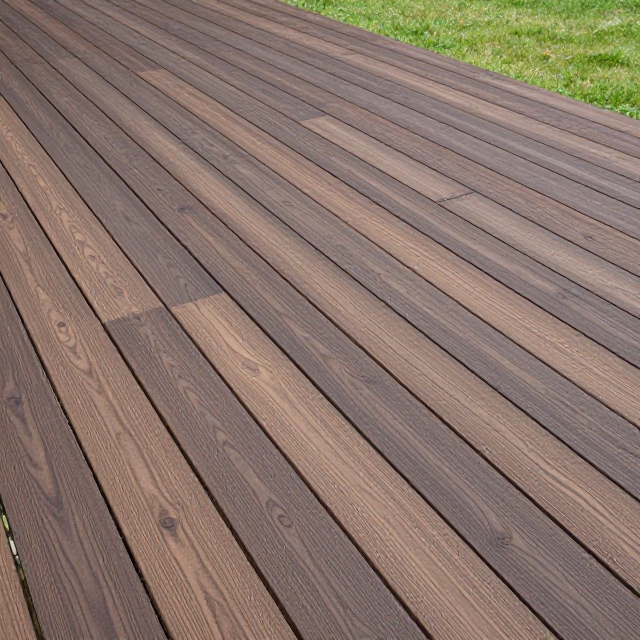
Thermowood decking is produced by heating sustainably sourced softwoods and hardwoods to high temperatures in a controlled steam environment, a process that removes moisture, strengthens the wood fibers, and permanently stabilizes the material. This heat-treatment dramatically improves resistance to rot, decay, insects, and warping while giving the wood a rich, refined appearance. The result is an eco-friendly, chemical-free decking option built to perform and last in outdoor environments.
Pine
Thermo-treated pine offers a warm, classic look with excellent dimensional stability and improved durability, making it a cost-effective choice for residential decking.
Spruce
Thermo-spruce has a lighter, cleaner appearance and becomes significantly more weather-resistant after treatment, ideal for modern, minimalist deck designs.
hemlock
Thermo-hemlock delivers a smooth, refined grain and enhanced strength, offering a premium feel with strong resistance to warping and outdoor wear.
ash
Thermo-ash is a dense hardwood with rich color and superior durability, providing a high-end decking surface comparable to tropical hardwoods.
Looking for composite decking options?
Check out our composite decking options. We can build with Timber Tech, Fiberon or Trex.
Wood Decking FAQs
When to consider new decking vs full new build?
There is not set answer as the condition of every individual deck can vary; however, for general planning purposes if your deck is less than 15 years old and was built correctly you might be able to save it by replacing the decking and doing some minor framing work. If it is 20 years or older than you probably need to seriously consider new framing as you would not want to put new decking on a frame that is not going to last.
What are the different types of wood to pick from?
When choosing wood for a deck in Snohomish County, some items to focus on are rot resistance, how the wood handles the Pacific Northwest's wet winters, maintenance, and overall cost. Some woods are naturally durable, while others depend on chemical treatment to resist rot and insects.
The main types of wood decking
1. Pressure-treated pine
Budget-friendly
Typical installed cost: $25–$45/sq. ft. for a complete deck
Lumber infused with preservatives to protect against decay and insects.
- Pros: Low initial cost, widely available, easy to work with.
- Cons: Can crack, warp, and develop splinters; needs regular cleaning and appropriate finishing.
- Best for: Budget-conscious homeowners who don't mind maintenance.
2. Western red cedar
Pacific Northwest favorite
Typical installed cost: $30–$55/sq. ft.
A lightweight, naturally rot-resistant softwood with a warm reddish-brown color.
- Pros: Attractive grain, easy to cut, naturally resists decay.
- Cons: Softer than many alternatives; can dent, fade, and weather to gray.
- Best for: A traditional wood appearance without the weight or cost of premium hardwoods.
3. Redwood
Typical installed cost: $35–$65/sq. ft.
A naturally durable softwood known for its rich reddish color.
- Pros: Good decay resistance in heartwood and a distinctive appearance.
- Cons: Can be expensive and less convenient to source locally; lower grades may have less durability.
- Best for: Homeowners who prefer a rich red finish and can obtain suitable-quality lumber.
4. Douglas fir
Typical installed cost: $25–$50/sq. ft.
A strong regional softwood with a prominent grain.
- Pros: Strong, attractive, and readily available in the region.
- Cons: Not naturally as decay-resistant as cedar heartwood; needs suitable treatment and careful moisture management outdoors.
- Best for: Selected applications where the lumber is specifically rated for exterior decking, or for structural framing when properly specified.
5. Ipe (Brazilian hardwood)
Premium
Typical installed cost: $50–$90+/sq. ft.
A very dense tropical hardwood with excellent natural durability.
- Pros: Long-lasting, hard-wearing, and highly resistant to rot and insects.
- Cons: Expensive, heavy, difficult to cut and fasten, and requires appropriate stainless-steel fasteners and predrilling.
- Best for: Premium decks where long service life is a priority.
6. Thermally modified wood
Typical installed cost: $40–$75+/sq. ft.
Wood that has been heat-treated to improve dimensional stability and resistance to moisture-related decay.
- Pros: Attractive natural appearance and generally less swelling and shrinking.
- Cons: Availability varies, costs more than basic lumber, and some products are more brittle than untreated wood.
- Best for: Homeowners who want a premium natural-wood look with improved stability.
Top three choices for Snohomish County
Best overall natural wood: Western red cedar
A good balance of local availability, appearance, and natural decay resistance. Choose quality decking boards and keep the structure well ventilated.
Best for a tight budget: Pressure-treated lumber
A practical option, especially if you use pressure-treated structural framing and choose a decking product specifically rated for the intended exterior exposure.
Best premium option: Ipe
Worth considering if you want dense, durable hardwood and are comfortable with a significantly higher upfront cost and specialized installation.
An important distinction: decking boards vs. framing
You don't have to use the same wood for both parts of your deck.
- Decking boards: The visible surface you walk on. Cedar, pressure-treated lumber, and hardwood are common choices.
- Joists, beams, and posts: The structural framework. Pressure-treated structural lumber rated for the relevant exposure is a common choice.
- Ground-contact components: Posts or framing exposed to soil or persistent moisture may require a specific ground-contact treatment rating.
In Snohomish County's wet climate, good drainage, ventilation, flashing, and appropriate fasteners can matter just as much as the species of wood you select.
One question to help narrow it down: Are you looking for the most affordable wood, the longest-lasting wood, or the best-looking natural wood? I can compare the best options for that priority.
Why seal the screw holes when re-framing a deck?
Sealing screw holes when reframing a deck is mainly about preventing water from entering the wood around fasteners, reducing rot risk, and protecting the connections that hold the deck together. In Snohomish County's wet climate, that can help extend the life of the framing.
However, there's an important distinction: not every deck screw hole needs to be individually sealed. The correct approach depends on where the screw is installed and what waterproofing system you're using.
How often does wood decking need to be re-stained?
For a wood deck in Snohomish County, Washington, a good general rule is to re-stain every 2–3 years, although the actual interval depends on the wood species, stain type, sun exposure, and how well water drains from the deck.
With the Pacific Northwest's frequent rain and damp conditions, moisture protection and regular cleaning are particularly important.
Pressure-treated wood: Every 2–3 years
Some decks need attention sooner, depending on exposure and the product used.
Cedar decking: Every 2–3 years
A heavily exposed deck may need recoating sooner; shaded cedar may develop moss or algae even if the stain remains intact.
Transparent or semi-transparent stain: Every 1–3 years
These finishes show the wood grain but generally need more frequent maintenance than more opaque coatings.
Solid-color deck stain: Every 3–5 years
Can last longer, depending on product quality and preparation, but may peel or wear in high-traffic areas.
These are planning estimates, not guaranteed product lifespans. Always follow the stain manufacturer's instructions.
Request a Quote