Timber Tech Pro Decks

Trustworthy, capable, and easy to work with. In an era where competent craftsmen are hard to find, I was pleased to find Mason Koivisto and High Rock Exteriors and Maintenance. Mason was quick to respond, provided a thorough and complete bid, and Calvin did excellent work in completing the project to install flashing to a cedar deck space where it had been overlooked by the original builder. All of this without having to wait weeks for project implementation. I highly recommend you get in touch with Mason for decking and maintenance/upgrading.
Timber Tech
TimberTech provides durable and low-maintenance decks with options to suit your style.
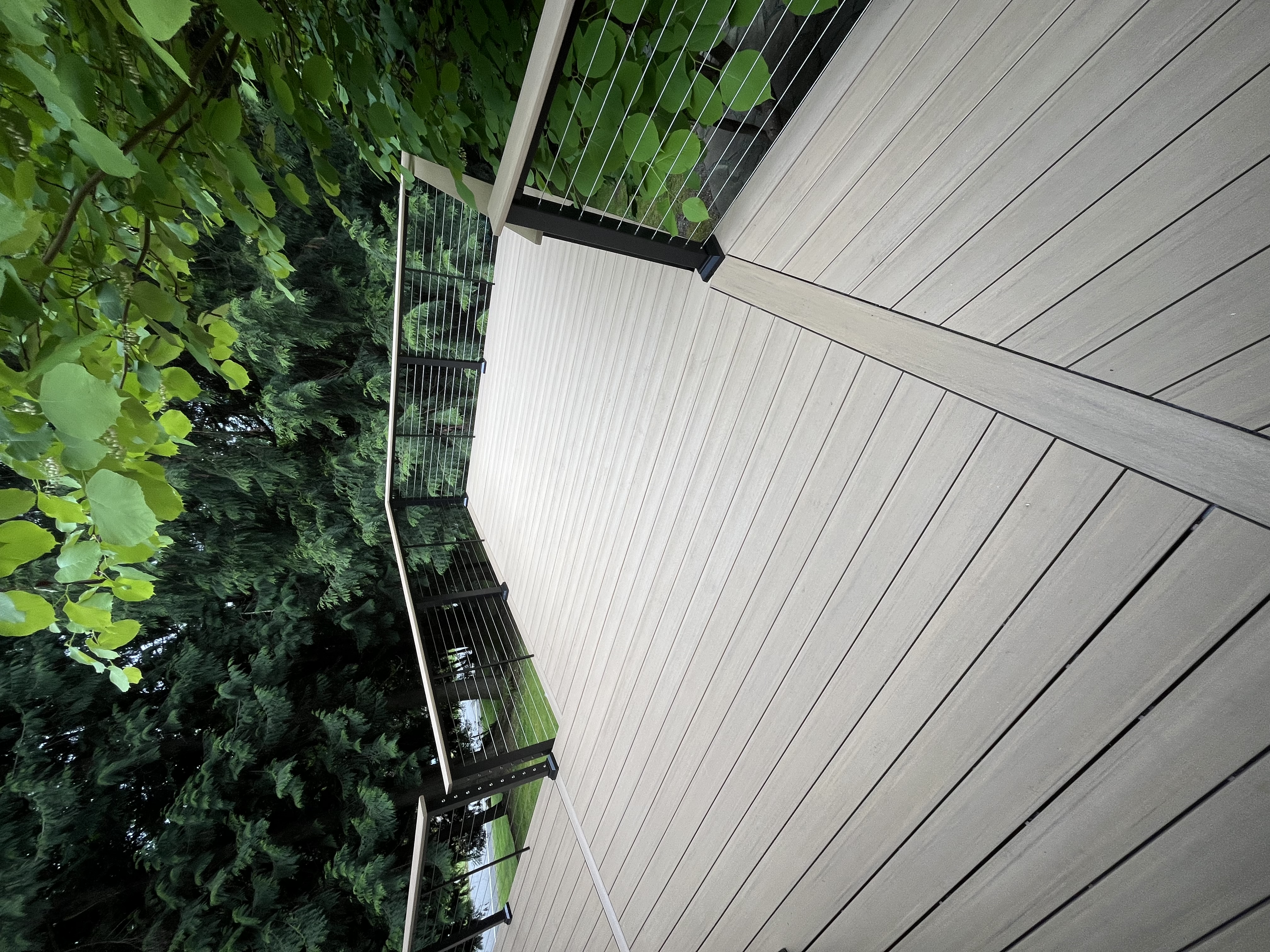
Advanced PVC
TimberTech's Advanced PVC (polyvinyl chloride) is made using their own proprietary technology that uses zero organic material making it highly resistant to moisture damage and is manufactured without producing toxins or waste. The product is full PVC.
Learn more >
Composite
TimberTech's composite decking uses a blend of synthentic and organic materials for the core and a four-sided polymer cap. The composite blend makes this product cheaper and it is available in more styles. The TimberTech Pro line is a better product while the Timbertech Edge line is more economical.
Learn more >
Fiberon
Fiberon provides high-quality composite decking and railing products easy outdoor living.

PVC Decking
Promenade PVC offers the aesthetic of high-end, handcrafted wood decking, with the benefits of premium PVC. Paramount PVC decking, a high-performance, low-maintenance choice that suits a busy, active lifestyle.
Learn more >
Composite Decking
Concordia premium PE composite decking combines classic and on-trend colors and grain patterns with unbeatable performance. Sanctuary decking is beautiful and easy to maintain and makes your backyard a place to stay. Good Life decking is perfect for creating a casual outdoor living space with an authentic wood look and is priced closer to wood. Armorguard is available exclusively at The Home Depot and provides an authentic wood look for your outdoor living space.
Learn more >
Trex
Trex is the composite wood deck industry pioneer and provides an excellent lineup of deck products.
Signature
Trex most durable decking is built with a photorealistic woodgrain, design-forward aesthetic and comes with a 50-year limited residential warranty.
Transcend Lineage
This line has heat-mitigating technology, making it the coolest decking yet, and a linear grain pattern with refined streaking. Also comes with a 50-year limited residential warranty.
Transcend
This option is curveable, highly resistant to scuffs and scratches, comes in rich colors, and has a grain pattern inspired by exotic woods. Also comes with 50-year limited residential warranty.
Select
Moderately priced with strong performance, this product is curveable with monochromatic colors. 35-year limited residential warranty.
Enhance
This most economical option has a scalloped underside making it lightweight and cheaper, but does include heat-mitigating technology in the Honey Grove and Tide Pool colors. 25-year limited residential warranty.
Learn more >
Looking for Wood decking options?
Check out our wood decking options. We can build with soft woods like cedar or hard woods like brazilian IPE.
Composite Decking FAQs
What are the major factors that affect composite decking cost?
The biggest factors affecting composite decking cost are the board brand and quality, deck size, framing requirements, and how complex the installation is. For a deck in the Snohomish County and around Monroe, it also helps to budget for local labor, site conditions, and moisture-management details suited to the Pacific Northwest.
Brand and product line
Entry-level composite boards generally cost less than premium collections with more realistic wood-grain patterns, richer color variation, or enhanced surface protection. Compare the same board length, width, and warranty tier when pricing brands.
Board construction and finish
Capped composite boards have a protective outer layer; uncapped products may be cheaper but can differ in stain, fade, and moisture performance. Board profile, thickness, surface texture, and slip-resistance features can also affect price.
Total deck area
More square footage usually means more decking, fasteners, and labor. Larger decks can sometimes lower the cost per square foot, but stairs, railings, and other features can offset those savings.
Layout and design complexity
A simple rectangle is usually the least expensive shape. Picture-frame borders, diagonal patterns, multiple levels, curves, breaker boards, and lots of cutouts increase material waste and installation time.
Fasteners and finishing details
Hidden fastening systems, color-matched screws, fascia boards, stair treads, and finished edges add cost. Face screws may be cheaper initially, but the appropriate method depends on the board manufacturer's instructions.
Substructure and site conditions
Composite boards still need a properly built frame. Replacing an old frame, correcting joist spacing, adding beams or footings, working on a slope, or accessing a raised deck can add substantially to the total.
Railings, stairs, and accessories
These can be major cost drivers. Aluminum or glass railings, long stair runs, lighting, benches, privacy screens, and skirting can add more than upgrading the deck boards themselves.
Labor, permits, and water management
Contractor rates, demolition and disposal, permit requirements, and drainage details all affect the installed price. If you want a usable dry area below an elevated deck, an under-deck drainage system such as TimberTech DrySpace is an additional budget item.
Getting estimates
For a meaningful estimate, make sure each contractor quote specifies the same scope. In particular, check whether it includes demolition, footings and framing, railings, stairs, fascia, permits, and under-deck drainage.
Our recommendation: If you're building new, decide on the deck's size, height, railing, and stair layout before choosing premium boards. Those structural and design choices can have a larger effect on the final bill than the difference between two composite product lines.
Do you have preferred composite decking brands?
For a composite deck in the Pacific Northwest, we like TimberTech, however Trex and Fiberon are also great products.
TimberTech is not automatically the best choice for every use and budget. We favor it when the priorities are a premium appearance, low-maintenance outdoor living, a coordinated finish, and the ability to choose between composite and PVC decking products.
Why we favor TimberTech
A premium, natural-wood appearance: TimberTech offers multiple color palettes and realistic grain patterns, including styles that emulate natural hardwood. That makes it easier to coordinate the deck with the home's siding, trim, and landscaping.
A good fit for the Pacific Northwest: Western Washington's frequent rain makes moisture management especially important. TimberTech's capped composite boards are designed to resist moisture, while certain collections feature four-sided protection. Its Advanced PVC line is another option when moisture resistance is a key priority. Proper framing, drainage, and ventilation are still essential.
Less routine maintenance than wood: You generally won't need to sand, stain, or seal TimberTech decking like traditional wood. Periodic cleaning is still necessary, and the exact care instructions depend on the product.
A coordinated outdoor-living system: Deck boards, fascia, railing, fasteners, and accessories can be selected to create a cohesive finished design. This is valuable when the goal is a polished, professionally finished deck rather than simply replacing the walking surface.
Long-term warranty coverage: TimberTech currently lists 25- to 30-year limited product and fade-and-stain warranties for its composite lines, and a limited lifetime product warranty plus a 50-year fade-and-stain warranty for its Advanced PVC line. Exact terms vary by collection, and a warranty does not mean the deck is maintenance-free or guaranteed against every type of damage.
What are some basic differences in PVC decking?
The biggest difference is that PVC decking is made entirely from plastic, while composite decking is typically made from a blend of wood fibers and plastic. Both are popular low-maintenance alternatives to traditional wood, but they perform a little differently—especially in Western Washington's wet climate.
PVC decking: Plastic throughout
- No wood fibers
- Very good moisture resistance
- Often costs more
- Can expand and contract with temperature
Composite decking: Wood fibers + plastic
- Often more affordable
- Wood-like look and feel
- Moisture performance varies by product
- Can contain more recycled or reclaimed material
What we would choose for your deck
- Choose PVC if you want maximum moisture resistance, especially for an elevated deck or an area exposed to frequent wetting, and you're comfortable with the potential price premium.
- Choose capped composite if you want a good balance of appearance, durability, and initial cost.
- Compare four-sided-capped composite with PVC, too. A well-protected composite board may be a better value than moving straight to a premium PVC product.
For TimberTech specifically, the comparison is between its Advanced PVC line and its Composite line. TimberTech describes Advanced PVC as having no wood or organic fillers, while its composite boards contain wood fibers and polymers; some composite collections have a protective cap on all four sides.
One final caution: PVC decking itself does not waterproof the area underneath your deck. If your goal is a dry covered patio below, you'll still need a separate drainage system such as TimberTech DrySpace, designed and installed for that purpose.
Request a Quote